
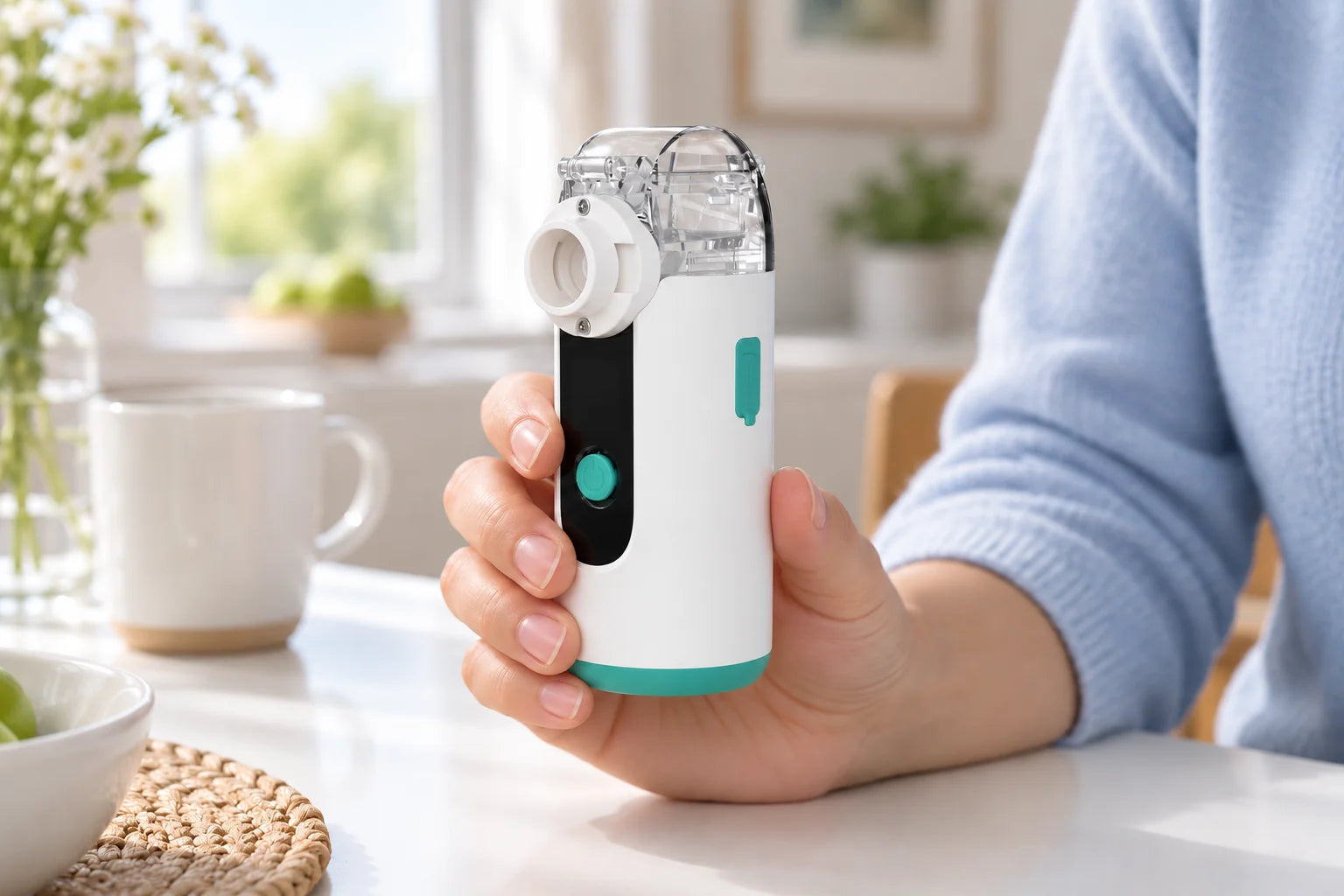
An “auto-clean” or “self-clean” label does not mean you can skip the rest of the care routine. It does not, by itself, establish disinfection. The cup, mask, mouthpiece and device body still need their own documented cleaning, drying and storage instructions.
Does auto-clean mean I do not need to wash it?
No—do not treat the feature name as a complete care routine. For a version that includes a cleaning mode, find these three parts of its instructions:
- Before the mode: which component is involved, what preparation is required and which materials are permitted.
- The mode itself: the exact start and finish sequence for that model.
- After the mode: any remaining cleaning, disinfection, drying and storage steps.
The name of the mode does not tell you that masks or mouthpieces are cleaned too. If the booklet does not make the scope clear, ask which parts the mode addresses. Do not infer a liquid, mixing ratio, run time or button hold from another device’s demonstration.
Work component by component
| Part | Locate this instruction | Do not infer |
|---|---|---|
| Medicine cup and lid | Whether and how the part may be removed; its cleaning, disinfection and drying steps. | That every removable cup or seal tolerates the same method. |
| Mask and mouthpiece | The method and replacement guidance for that accessory. | That a device cleaning mode also cleans its attachments. |
| Device body and charging connection | Permitted exterior care and restrictions around moisture. | That the body can be immersed because the cup can be detached. |
| Air tubing, where supplied | Whether the guide specifies care or replacement and how. | That tubing follows the mask’s washing method. |
A missing instruction is a reason to identify that part’s method, not to choose a stronger cleaner or add heat.
One care step is unclear—what should I ask?
“On [model], page [number] calls this [cleaning/self-clean mode]. Does it apply to [cup / mask / other part]? I can follow [step], but the instruction for [preparation / starting / finishing] is unclear. Please explain that step.”
For tiny print, first try the readable-instructions steps. Keep the entire care page, including its warnings, visible in your photo.
Before putting it away
- Complete the drying and storage steps for each part in the supplied instructions.
- Keep parts awaiting care separate from those already prepared for storage.
- Keep the booklet with the device so the same routine is available next time.
- Use the specified storage conditions; for travel, review the packing and power checklist.
I cleaned it, but mist is still weak or stops
Do not keep repeating or intensifying the cleaning process to diagnose an output problem. Keep a short record: the part cleaned, method or booklet step used, when it was done, and whether output changed immediately or after storage.
Then use weak-mist and stopping guidance. Include that care record in the same equipment request. It is useful context, not proof that you caused the problem.
Ask about one care step
Include the component and the missing action; you do not need to repeat unrelated setup details.
- The part involved and the full device code
- Care page/heading and the specific preparation, mode or finishing step that is unclear
- For an output change: the method already used, when, and what changed